



Current Project Start: About 2 weeks
Next Available Estimate: Within 48 hours
Local Permit Wait Time: About 2 weeks, if necessary
171 Google
Reviews
25+ Years in Anne
Arundel County
MHIC #97820
Licensed & Insured
A+ BBB
Rating
Owner-
Operated
Workmanship
Warranty Included
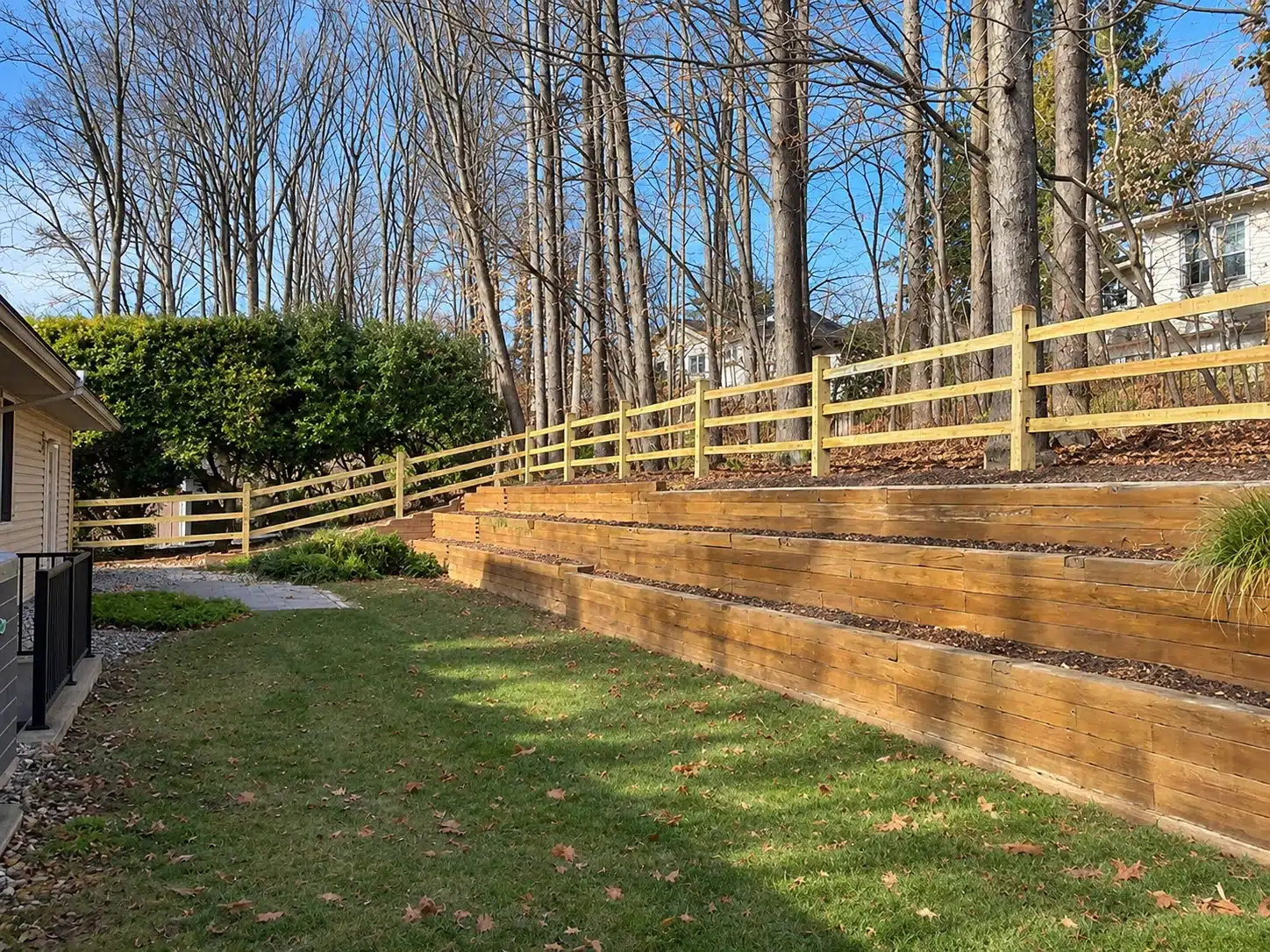
A split rail fence is the go-to choice across Anne Arundel County when the goal is to define a property without closing it in. It creates a clean boundary line, keeps sightlines open, and fits naturally into the landscape, whether that’s wooded lots, open acreage, or waterfront property.
It is also one of the most cost-effective ways to mark property lines, contain horses with the right setup, or bring structure to a yard without adding visual weight.
We have been doing split rail fence installation projects throughout the county since 1999. Jeremy or Jim walks every property themselves, and the same crew that measures your lot handles the installation. There are no subcontractors and no handoffs.
That consistency matters. It is how projects stay on track and how details do not get missed.
Anne Arundel County’s mix of rural and suburban properties, from Gambrills and Davidsonville to waterfront lots along Stoney Creek and Bodkin Creek, makes rustic fence styles a natural fit. Split rail works just as well on five-acre parcels as it does on half-acre lots. In HOA communities where privacy fencing is restricted, a 2-rail or 3-rail configuration is often the approved alternative.


At its core, a split-rail fence is a post-and-rail fence built with mortised posts and interlocking rails. The rails slide through holes cut into each post, with no nails, screws, or visible brackets.
That construction is what gives the fence its continuous, finished look. The rails are not attached to the face of the post; they pass through it. From a distance, the entire run reads as one uninterrupted line.
In Anne Arundel County, this style works well for:
Where it does not fit: full privacy, commercial security, or pool compliance on its own. If those are the priorities, we recommend alternatives during the estimate, such as privacy fence installation or code-compliant pool fencing.
Anne Arundel County is classified with severe weathering and moderate to heavy termite pressure. That directly affects how long a split rail fence will last, since posts and rails sit close to or in the ground for decades.
We install four material options:

A true split rail fence uses mortised posts and interlocking rails. A bracketed version relies on metal hardware.
They may look similar at first, but over time, the difference shows. Brackets loosen, screws back out, and rails begin to sag. Mortised construction holds its shape because the connection is built into the material itself.
We install true split rail systems for that reason.
Rail count is determined by function, not style.

Used primarily for visual boundaries. It defines property lines without providing containment. Most common for residential yards and HOA compliance.

The standard for horse and livestock containment on residential properties. The additional rail reduces spacing and increases effectiveness.

Typically used for larger or commercial equestrian properties.

Posts spaced at 10–11 feet instead of 8. Common on long acreage runs, creating a more open look while reducing post count.
We recommend the configuration based on how the fence will be used, and not to increase the cost.
Split rail fencing alone does not contain smaller animals. Wire mesh is added to the back of the fence to provide containment without altering the appearance from the front.
Options include:
For pool compliance, a 3-rail system with 1″x2″ mesh and a compliant gate can meet requirements when properly specified.
Mesh is installed during the build. Retrofitting later is more labor-intensive. If keeping a dog in the yard is the main reason for your fence, you can also compare our dog fencing options before your estimate.
Anne Arundel County sets the frost line at 30 inches, with wind exposure and soil variation affecting every install.
We contact Miss Utility (811) before excavation and work around marked lines.
Posts are set below the frost line. Depending on soil conditions, we use compacted stone or concrete. Structural posts always receive concrete.
We match materials to soil, moisture, and exposure, especially on waterfront or wooded lots.
Ground-contact-rated materials are standard. Untreated softwoods are not used.
We plan for slope and terrain before digging to avoid mid-install changes.
Most properties in Anne Arundel County involve at least one complication:
Waterfront fences require a permit, and tidal properties can fall under Critical Area rules, so we confirm setbacks and flood zones during the estimate. Black locust and vinyl are strong choices where the ground stays damp.
We plan the layout around the grade before any digging starts. That way, the fence line is set for the terrain instead of being adjusted mid-install.
We match materials to the soil and moisture conditions on the lot. Ground-contact-rated materials are standard, and untreated softwoods are not used.
Long runs on larger parcels often use ranch spacing, with posts 10–11 feet apart to reduce the post count. Larger projects also lower the per-foot cost, and field fence can be added for mixed livestock.
We review these conditions during the on-site estimate, so your written quote reflects your property instead of a standard layout.
Key points for Anne Arundel County:
We handle permits, HOA submissions, and utility coordination as part of the project.
Jeremy or Jim evaluates the property, measures the layout, and provides a written quote.
We coordinate permits, HOA approval, and utility marking.
Posts are set, rails installed, and adjustments made based on site conditions.
We inspect alignment, stability, and overall finish with you before completion.
Cost depends on:
Key factors:
All pricing is provided after an on-site estimate.
"Our new fence looks great! The communication from start to finish was amazing! Jim kept in touch all day as the fence was installed. Sheila in the office was helpful and great to deal with. Looking forward to our next project! I would highly recommend!"
"All Around Fence did a fantastic job from start to finish. Jeremy met with me several times to discuss fence design and answer all my questions (which were many). Sheila, from the office, was also very responsive to my questions and kept me informed on the schedule. A great company to work with that I highly recommend. You will not be disappointed with their work."

Most fences under 6 feet do not need a permit in Anne Arundel County, but there are exceptions. Waterfront, pool, and corner lot fences require permits; Annapolis City has separate requirements, and HOA approval comes before any permit. We handle permits, HOA submissions, and utility coordination as part of the project.
Cost varies by material, total length, and ground conditions. A 3-rail fence typically costs 20–30% more than 2-rail, and wire mesh adds approximately 25–35%. All pricing is provided after an on-site estimate.
Posts are set 30–36 inches deep, below Anne Arundel County’s 30-inch frost line. Depending on soil conditions, we use compacted stone or concrete, and structural posts always receive concrete.
Yes, and we recommend it for pets and livestock. Options include 2″x4″ welded wire, 1″x2″ welded wire, and field fence. Mesh is best added during the build, since retrofitting later is more labor-intensive.
It lasts 15 to 50 years, depending on the material. In Anne Arundel County, pressure-treated pine lasts about 15–20 years, Western Red Cedar 20–25 years, vinyl 30+ years, and black locust 30–50 years.
Choose 2-rail for visual boundaries and 3-rail for containment. A 3-rail fence is the standard for horses and livestock on residential properties.
Often, yes. In HOA communities where privacy fencing is restricted, a 2-rail or 3-rail configuration is often the approved alternative. HOA approval comes before permits, and we handle the submission as part of your project.
Work directly with the installer from start to finish. No handoffs, no subcontractors.
"I cannot say enough great things about my experience with the team at All Around Fence. From working with Sheila to gather info and set the whole project up, to the owner, Jim, who handled the initial visit and provided confirmation on our decision, and Patrick and his team who were on site for installation. The entire process from beginning to end took approximately 3 weeks, including a weather delay, and the price was well under what I was anticipating. Cannot recommend more!"