Most homeowners start with a photo, but the fence that looks right in a photo doesn’t always hold up the same way on your property. Style and structure aren’t the same thing, and confusing them is the most common way people end up with a fence they’re unhappy with two years in.
We’ve been installing wood fences across Anne Arundel County for 25 years — board-on-board in tight suburban lots off Mountain Road, split-rail on larger lots in Gambrills, shadowbox on waterfront properties near the Patapsco, and picket fencing on HOA-governed streets in Severna Park and Arnold. What works well depends less on what looks good in a catalog and more on how a fence is built and where it’s being built.
This guide covers six wood fence styles: what each one is, how it performs, what it’s best suited for, and where it tends to struggle.


What this guide covers:
Style is what you see. Structure is what determines how long it lasts.
The same style can be built two different ways — and one will outperform the other significantly. Board-on-board fencing built with posts set in concrete below the frost line holds differently than board-on-board with posts surface-mounted to a concrete pad. The visual result on installation day is the same. After a few Maryland winters, it isn’t.
That’s why this page covers both layers for each style. The wood fence installation page goes into structural detail: post depth, rail spacing, and hardware. This page handles the style layer.
Board-on-board is the most common privacy style we install across Anne Arundel County. Vertical pickets overlap on a single face of the fence — each board covers part of its neighbor, with no visible gaps. The result is a solid visual barrier from any angle, any distance.
The overlap does something else, too — it distributes wind load across the rails instead of each board taking it independently. On exposed lots, that difference shows up in post failures and blown boards over time.
Best suited for: Backyards, side yards, and any run where full visual privacy is the priority. Works on most lot types across Anne Arundel County.
What to watch for: Board-on-board has more surface area exposed to moisture. The wood expands and contracts with Maryland’s humidity cycles — wet summers, dry winters. Boards should be installed with a small gap between the bottoms and the ground, and species selection matters more than most people expect. That decision is covered on the types of wood page, but it’s worth raising now.
Style variations: Dog-ear (notched top corners), flat top, French Gothic (pointed center), and Gothic cap (pointed with decorative trim). These affect appearance only — not structural performance.
Field note — Year 0 vs. Year 2: Fresh board-on-board looks tight and uniform. By year two, pressure-treated wood has dried and seasoned, and small gaps may open between boards. This is normal — the wood is reaching its stable moisture content, not failing. Board-on-board is designed with enough overlap that these gaps don’t compromise privacy even after the wood settles. Significant warping or boards pulling away from rails in year two is a fastening or post issue, not a style issue.
Shadowbox looks nearly identical to board-on-board from straight on — the difference is in how it’s built. Shadowbox alternates pickets on opposite sides of the rail — one board on the front, next board on the back, with a small gap between them. From a direct line of sight, the overlap blocks the view. From an angle, you can see light through it.
On properties near the water — Riviera Beach, Lake Shore, Bar Harbor, Rock Creek — a fully solid fence acts like a sail when wind comes off the Bay or the Patapsco. Shadowbox’s alternating gaps allow some air to pass through, which, in our field experience on exposed Anne Arundel lots, tends to reduce stress on posts and rails compared to fully solid construction on the same soil. The engineering difference is debated, but the pattern we see on shoreline properties holds up consistently.
Best suited for: Lots with open exposure to wind, situations where privacy matters but some airflow is a benefit, properties where a slightly lighter visual weight is preferred.
What to watch for: The gap means some light and air pass through. If complete visual blockage is the goal — particularly from elevated angles, like a neighbor’s second-floor window — board-on-board is the stronger choice.
Field note — Waterfront properties: Coastal air carries salt and moisture. That affects material choice more than style choice — but style affects surface area, and surface area affects exposure. Shadowbox’s alternating pattern means both faces of each board see the weather. On shoreline lots, wood species and treatment grade become especially important. Explore wood species options.
Stockade uses pointed-top pickets set flush against each other — no spacing, no overlap. All boards face the same direction, set edge-to-edge on the rails. It produces a solid barrier, built and finished differently than board-on-board.
Stockade is faster to build and costs less per linear foot. It works well for utility runs — side yards, around HVAC equipment, perimeter lines that need enclosure without a finished appearance on both sides. It’s common in Brooklyn Park and Ferndale, where the goal is enclosure rather than curb appeal.
Best suited for: Utility enclosures, side yards, secondary fence runs where function matters more than appearance.
What to watch for: Stockade’s flush pickets sit tight against each other with no overlap. As the wood seasons and boards narrow slightly, thin gaps can form between pickets — more visible than the normal settling of board-on-board because there’s no overlap to compensate. On front-facing or high-visibility runs, board-on-board gives a more finished long-term result.
Style note: The pointed top is the traditional stockade profile. Flat-top stockade is available — it reads more modern and sits more cleanly under cap trim if you want a finished top line.
Classic vertical picket — spaced boards on horizontal rails, typically 3 to 4 feet tall. The boards don’t touch; the spacing is part of the design. It defines a boundary without blocking views or light — a natural fit for front yards, garden borders, and decorative property lines where an open feel is the goal.
In HOA-governed communities around Severna Park and Arnold, full-height solid fencing is often restricted on front-facing property lines. A 3- or 4-foot picket fence typically satisfies those rules where a 6-foot privacy fence would not. That’s worth checking against your specific CC&Rs before making a final decision.
Best suited for: Front yards, garden enclosures, decorative boundary lines, HOA communities with height or opacity restrictions on front-facing fencing.
What to watch for: Picket fencing doesn’t reliably contain dogs. Spacing between boards and the lower height make it easy for most dogs to push through, dig under, or clear. For pet containment with picket aesthetics, a wire mesh backing can be added — but a cleaner solution is usually a different style. Pet containment fencing options are worth considering.
Top profiles: Pointed (traditional), flat top (contemporary), dog-ear (simple notched corners), French Gothic (pointed center). All functions are identical; the profile is the final choice.
Split-rail uses rustic logs split lengthwise, slotted into drilled posts — typically 2 or 3 rails high. Post-and-rail uses milled lumber with cleaner, more uniform profiles, either mortised into posts or surface-mounted with brackets. Both styles are open by design. From the street, they read as boundary markers rather than enclosures — the property line is defined, but nothing is blocked.
These styles work best on larger lots in Gambrills, Jacobsville, and rural-edge communities where the property can carry the scale, and the open look fits the surroundings. On smaller suburban lots in Glen Burnie or South Gate, split-rail tends to feel out of proportion — it won’t contain pets, won’t give privacy, and won’t mark a tight urban property line cleanly.
Best suited for: Large lots, rural-feel properties, front-of-property decorative boundaries, anywhere an open visual marker serves better than an enclosure.
What to watch for: The rail slots where logs seat into posts are the first place rot appears if water sits. Cedar is the standard choice for longevity on split-rail; pressure-treated works, but the look is different. Species considerations are covered on the types of wood page.
Adding wire mesh: Split-rail is commonly combined with wire mesh or welded wire backing for pet containment, maintaining the open visual while creating an actual barrier. This changes the installation meaningfully and is worth discussing before finalizing the design.
Crossbuck panels use an X-pattern built into a rectangular frame. The design is decorative by nature; it defines a space and adds visual interest without blocking sightlines. From the street, it reads as deliberate and finished without feeling like a barrier. Common applications include vegetable garden perimeters, driveway entrances, transitional fence runs between a privacy section and an open yard area, and horse property where the style is traditional.
It’s a boundary marker with character — and in the right application, exactly the right call.
Best suited for: Decorative boundaries, garden enclosures, property definition where openness is preferred, rural and farmhouse-style properties.
What to watch for: The diagonal cross members are angled to trap and hold moisture at joint points. In Maryland’s humid summers, those joints are the first places to show wear if the wood isn’t properly treated. Panel replacement is more involved than replacing individual boards on a standard fence.
| If your priority is… | Consider… | Why |
|---|---|---|
| Full backyard privacy | Board-on-board | Solid from every angle; overlap compensates for wood movement |
| Privacy on a windy or waterfront lot | Shadowbox | Alternating gaps reduce wind stress on posts |
| Utility enclosure, lower cost | Stockade | Faster build, costs less per linear foot |
| Front yard or HOA compliance | Picket | Open design typically passes height restrictions |
| Large lot, decorative boundary | Split-rail or post-and-rail | Open visual marker that scales to larger properties |
| Garden border, rural aesthetic | Crossbuck | X-pattern panel; decorative boundary without enclosure |
The right style isn’t just about what looks good — it’s about what fits the site.
The close-neighbor geometry of Pasadena, Glen Burnie, and South Gate means privacy is almost always the functional priority. Board-on-board and shadowbox dominate here because they solve the actual problem. Decorative styles end up feeling like the wrong answer once the neighbors can still see directly into the yard.
Most wood privacy styles are built stepped — the fence runs in level sections that stair-step down a grade, creating a clean horizontal top line. Split-rail and post-and-rail can be racked to follow the slope continuously, which looks more natural on gradual grades. On steep slopes, stepped construction is the more structurally sound approach for privacy-style fencing.
Properties along the Patapsco waterfront, in Riviera Beach, Lake Shore, and the shoreline communities around Rock Creek, face different conditions than inland suburban lots. Wind, salt air, and persistent humidity affect how a fence ages. Shadowbox or open styles reduce the surface area exposed to wind loads. Material selection matters more here than anywhere else in the service area.
HOA fence rules vary considerably even within the same neighborhood. The most common restrictions affect front-yard height and opacity — typically limiting fencing above 4 feet or requiring open styles on front-facing runs. Picket tends to navigate those rules more cleanly. Always review the specific CC&Rs for your community before committing to a style.
Style and slope — what stepped fencing actually looks like:
When a privacy fence runs across a sloped yard in stepped sections, each panel is level, and the bottom steps down to meet the grade. On a steep slope, those gaps can be significant enough to be a concern for pet containment or to defeat the privacy intent. There are ways to address this at installation (infill boards, concrete mow strips, additional bottom boards). Worth raising before the project starts, not after.
We’ll measure your property and walk you through material options on-site.
Get a free estimate or call (443) 201-1366.
The fence you get on installation day is not the fence you’ll have in two years. That’s not a defect — it’s how wood works. Understanding how different styles age helps set realistic expectations.
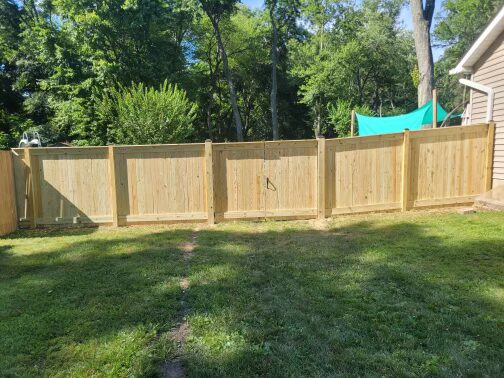
Fresh pressure-treated lumber has a green tint from the copper-based preservative chemicals infused during treatment, and is often damp from the water-borne treatment solution. Boards are tight, and everything looks uniform. Some boards may show minor checking (surface cracks along the grain) — this is normal and cosmetic only.

The wood dries and seasons. Boards narrow slightly as moisture content stabilizes. On board-on-board and shadowbox fencing, small gaps open where boards previously looked tight. Posts settle as the concrete footing cures fully.
Color shifts toward gray or silver if the wood is left untreated — a normal weathering pattern for pressure-treated pine, not a sign of failure.
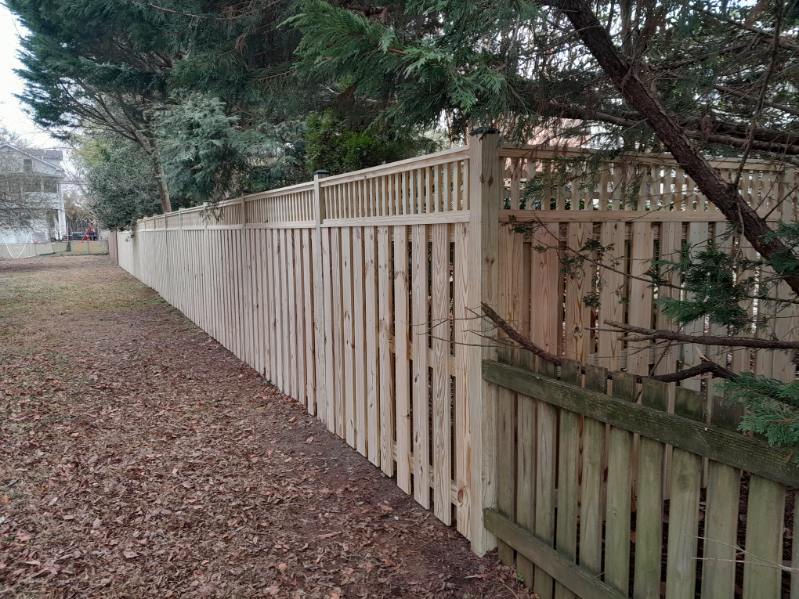
The fence reaches its stable state. Well-built fencing with properly set posts should show no significant movement from this point. At that stage, problems trace back to installation — not the style.
The moisture trap risk by style: Styles that create tight board-to-board contact are more vulnerable to moisture accumulation. Stockade fencing with boards set flush and crossbuck panels with diagonal joint points holds moisture longer than styles with designed airflow. This doesn’t mean those styles are wrong — it means material selection and finishing matter more for those styles than for open or semi-open designs.
Board-on-board uses overlapping pickets on a single face of the fence — fully solid from any angle. Shadowbox alternates pickets on opposite sides of the horizontal rail with a small gap between them. From straight on, both provide essentially the same privacy. From an angle, the shadowbox allows some light through. On exposed or waterfront lots, shadowbox tends to place less stress on posts over time due to its alternating-gap design.
Board-on-board and stockade provide the highest level of visual privacy — no gaps, no sightlines from any angle when the fence is new. Board-on-board maintains that coverage better over time because the overlapping design compensates for normal wood movement. Shadowbox provides considerable privacy from various viewing perspectives due to its proximity. Picket, split-rail, and crossbuck styles are open by design and don't function as privacy barriers.
Yes, but slope affects how the installation works. Most wood privacy styles — board-on-board, shadowbox, stockade — are built in stepped sections that stair-step down the grade with a level top on each panel. Split-rail and post-and-rail can be racked to follow the slope more gradually. The approach depends on the grade's steepness and the desired finished result.
Front-yard HOA restrictions typically target height and opacity rather than style. Lower picket fencing — 3 to 4 feet, open design — passes HOA review more often than full-height privacy fencing in communities with front-yard rules. Backyard fencing is usually governed more loosely. Always review your specific CC&Rs before choosing — rules vary by community even within the same zip code. Know the rules for fence permits in Anne Arundel County.
Open styles — split-rail, post-and-rail, picket — have less surface area exposed to moisture and generally require less maintenance than solid-privacy styles. That said, the maintenance need is driven more by wood species and treatment than by style. A properly treated board-on-board fence with the right species will outperform an untreated split-rail fence over time.
Style is one part of the decision. If you know what you want, we can start with measurements. If you’re still deciding, a 15-minute site visit usually answers what hours of research can’t.
All Around Fence has installed wood fencing for homeowners across Anne Arundel County for 25 years — 78 Google reviews reflect what that experience looks like in practice. We serve Pasadena, Glen Burnie, Severna Park, Annapolis, and communities throughout Anne Arundel County.
Get a free estimate or call (443) 201-1366 to talk through your project.